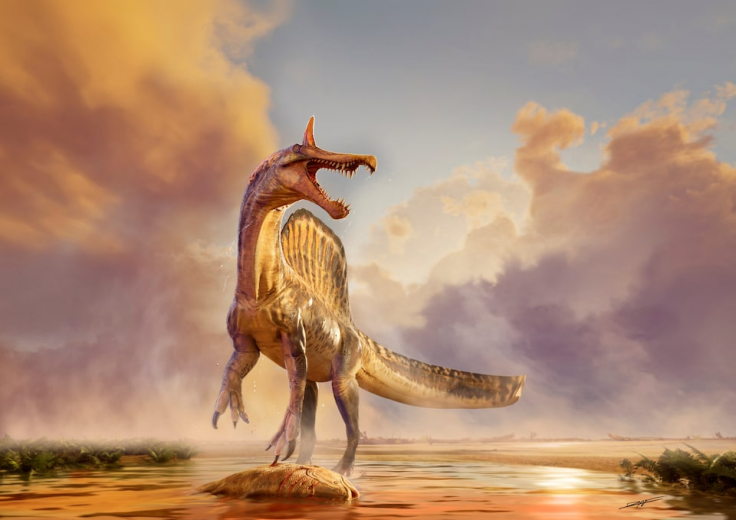
- Scientists discovered Spinosaurus mirabilis fossils in Niger's Sahara Desert.
- Remains include three skulls; species lived 95 million years ago.
- Fossils found inland, challenging fully aquatic predator hypothesis.
- Study published Thursday in Science journal; expedition occurred 2022.
In the Sahara Desert of Niger, scientists have discovered fossils of a new kind of Spinosaurus, a discovery that can shed new light on one of the largest predators of dinosaurs to have ever lived on Earth. It was named Spinosaurus mirabilis; it was approximately 40 feet (12 meters) in length, and 5 to 7 tons in weight, making it one of the largest meat-eating dinosaurs.
The remains were discovered at the remote location of Jenguebi where sand dunes and sandstones form outcrops. The scholars discovered components of three skulls and other bones. The find was reportable on Thursday in the journal science and it is the second known species in the genus Spinosaurus.
The dinosaur, which had lived approximately 95 million years ago in the Cretaceous Period lived in what was a hot, inland climate with rivers cutting across it. The fossils of the Spinosaurus that had been found in Nigeria were found in between 300 and 600 miles of the nearest ancient coastline implying that the creature lived in fresh water.
Unique Crest and Fish-Hunting Modifications
The new species is characterized by a large and scimitar-like bony crest that protrudes nearly 20 inches (50 cm) off the skull top. Researchers have termed the crest solid bone, which was probably covered with keratin and it was also possibly brightly colored. Its long snout and interlocking teeth of conical shape were designed to hold slippery fish thereby supporting the idea of a specialized diet.
It is, said paleontologist Paul Sereno of the University of Chicago, who is the lead researcher on the study, about love and life - finding someone to share a hot meal with, protecting your hot feeding shallows. What more important could there be?
The nostrils of the dinosaur were placed further back on the skull and this allowed the dinosaur to dunk most of its snout when breathing. Its teeth are tightly interlocked and interlaced with one another in a process referred to as interdigitation. The functional advantage of this arrangement was explained by paleontologist Daniel Vidal, one of the co-authors of the research.
With no serrated teeth and interdigitating large conical teeth composed of a fish trap that is quite effective in piercing and entraping slippery fish in the cones, according to Vidal of the University of Chicago and the Universidad Nacional de Educacion a Distancia in Spain.
The Fully Aquatic Hypothesis is a hypothesis that has been challenged
Spinosaurus has been a subject of study among scientists since there has been an unusual structure in its body; it has elongated dorsal spines that constituted a sail-like structure on its back. The fossils of the already known species, Spinosaurus aegyptiacus, were discovered in the area of the former coastline of the ancient Tethys Sea, which made some scientists think that the dinosaur was entirely aquatic and could even swim in open water.
The fact that Spinosaurus mirabilis was found inland makes that theory harder. Its structure, and the geographic circumstances of its discovery, suggest that it was better adapted to be a shallow-water predator, as opposed to a deep-diving marine predator.
Spinosaurus mirabilis possesses some of the most divergent piscivorous adaptations of any dinosaur thus we know that it more readily predated on fish than on predatory dinosaurs, Vidal said.
Sereno has termed the new evidence as conclusive in the argument. The death-stroke to the aquatic theory, he said, was the conception that Spinosaurus was a marine predator.
The fossils were found on a trip organized in 2022 which started in Agadez, where researchers ventured off road which required almost three days on a desert terrain. The fossil-bearing outcrops were often accessed under very difficult circumstances such as vehicles getting trapped in sand before accessing the fossils.
Other Early Species
Besides the remains of Spinosaurus, the team discovered fossils of other early species, including large fishes like coelacanths, which served the explanation of a river-based ecosystem.
Spinosaurus has been in comparison with other large predators such as Tyrannosaurus, Giganotosaurus and Carcharodontosaurus. Although it has been popularly known thanks to the depiction it receives in the Jurassic Park films, additional fossil records keep changing the current scientific knowledge about its biology and habitat.
The discovery of Spinosaurus mirabilis advances the information on the diversity of dinosaurs in Cretaceous Africa and provides new information concerning the adaption of large predators to specialized ecological niches. Scientists opined that more examination of the recently discovered material can help explain how several Spinosaurus species lived and died at close periods.
The finding highlights the ongoing scientific relevance of isolated Saharan fossil locations, which have continued to yield much paleontological information decades since the first Spinosaurus fossils to be identified.
Recommended FAQs
When was Spinosaurus mirabilis discovered in Niger?
The fossils were uncovered during a 2022 expedition in the Sahara Desert near Jenguebi, Niger. The findings were later reported in the journal Science, confirming it as a newly identified species within the Spinosaurus genus.
How big was Spinosaurus mirabilis compared to other predators?
Spinosaurus mirabilis measured about 40 feet long and weighed between 5 and 7 tons. That makes it one of the largest known meat-eating dinosaurs, comparable in size to Tyrannosaurus and other giant Cretaceous predators.
Did Spinosaurus mirabilis live in water or on land?
Fossils were found hundreds of miles inland from the ancient coastline, suggesting it lived in freshwater river systems rather than open seas. Its anatomy supports the idea that it was a shallow-water predator rather than a fully marine dinosaur.
What makes Spinosaurus mirabilis different from other Spinosaurus species?
It had a large, scimitar-shaped bony crest rising nearly 20 inches from its skull. Its tightly interlocking, conical teeth were specially adapted for catching slippery fish, highlighting a highly specialized piscivorous diet.
Why does this discovery challenge the fully-aquatic theory?
The inland fossil location and anatomical features suggest it was adapted to rivers and shallow waters instead of deep marine environments. This weakens the theory that all Spinosaurus species were fully aquatic, open-water predators.


