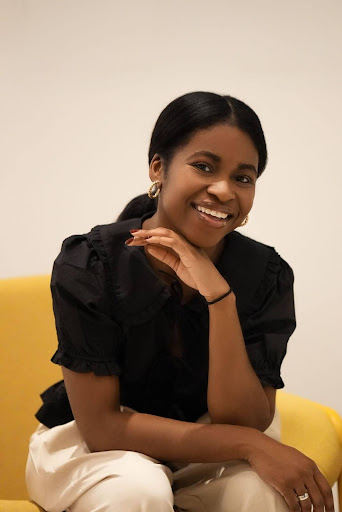
In 2022, Devora Otuonie came to the United States and received an invitation from the owners of the Ode à la Rose floral studio chain to head a new branch in Miami. She built a team of professional florists from scratch, established processes, and for three years now, during peak seasons, she creates thousands of bouquets and sends them across the country to clients who value premium quality and service. The designer and artist shared her life hacks for managing a floral studio, discussed the essential skills of a professional florist, and reminded us why artists shouldn't be afraid of competition from AI.
Devora Otuonie grew up and studied in Kyiv, received an art education, and became an artist. She painted portraits in various styles, her works were exhibited in galleries and participated in international competitions. Over time, she became interested in floristry – she wanted to work not only with paint and canvas, but also with something that breathes, withers, and changes every day, Devora recalls. In Kyiv, she organized events and decorated them with large-scale floral arrangements.
In 2022, Devora moved to the USA, and her career took off. She continued to develop both as a portraitist and as a floral designer. Her organizational skills and management abilities, along with her artistic taste, were noted by entrepreneurs from the French company Ode à la Rose. The new branch in Miami opened a few months ago, and the top management team was looking for a manager with the right qualifications for it. Thus, Devora became the head of Ode à la Rose and has been successfully leading teams of designers, florists, and logistics personnel at the Miami branch for three years. Year-over-year, the studio's sales on Valentine's Day increased by 83%. During peak times for florists in the US, Mother's Day and Valentine's Day, her branch makes around 2,000 bouquets in two days.
To bring the branch to the desired sales level, the team size needed to be increased to 15 people. The manager herself hired specialists and trained them to work to the high standards of Ode à la Rose. Based on Devora's experience as a manager and designer, a successful florist needs to have far more than just artistic taste. This is just the foundation and starting point for a true professional. A strong florist also needs compositional thinking and spatial imagination – they must be able to see not just an individual bouquet, but the whole picture: the interior, the light, the people, the camera. Speed and stress resistance are also important. Floristry always involves tight deadlines, especially during peak seasons: Mother's Day, Valentine's Day, and other holidays.
Devora also values technical skills in her colleagues: working with various frameworks, mechanics, suspended structures, proper handling and storage of flowers. Organizational and management skills are important. If a florist is managing projects and a team, they need to be able to plan shifts, purchases, logistics, and the budget. Devora also highlights among the qualities the ability to understand the client, ask the right questions, and gently guide them toward solutions that will look beautiful and are realistically achievable. Devora defines the final skill as basic analytics: calculating costs, margins, forecasting demand and inventory without this, floristry as a business cannot survive.
Over three years of working, Devora has successfully structured the team's work to handle the order flow while maintaining quality. Among the tools and solutions that led to such a successful management outcome, she mentions first and foremost very clear processes. In Devora's studio, she has checklists for every stage: from receiving the flower to packaging the order. Also, standards for each product, with photos and technical diagrams. And also a system of priorities based on delivery time and complexity.
Second, proper role distribution. "Some people are faster and neater at assembling single-flower bouquets, some are perfect at creating complex arrangements, and some are strong in communication and customer service. I try to see the strengths in everyone and structure the shift so that people are doing what they are most effective at," shares Devora.
Thirdly, feedback and learning. Devora regularly shows the team references, explains why things are done a certain way in the studio, and conducts mini-trainings on composition, working speed, and flower processing. "This helps maintain quality at a consistent level, even when the order flow is very large," Devora assesses.
Based on Devora's experience, novice florists often make similar mistakes. For example, they try to "fit everything in" into a single bouquet, resulting in an overload of flowers, textures, and shades. They also tend to hold the flowers too tightly, leaving no space for air or movement. Additionally, beginners frequently underestimate the importance of technique they neglect proper cutting, hydration, and temperature control, which causes the bouquet to wilt quickly.
When it comes to business processes, it's important for a beginner florist not to be afraid of communicating with clients and not to hesitate to ask clarifying questions. Otherwise, expectations and the final result won't match, and the client will be left dissatisfied. Novices often fail to calculate costs and end up working at a loss because they focus solely on the aesthetic side. "I always say: beauty + math + process. Without these three components, floristry turns into chaos," summarizes Devora.
Ode à la Rose is a premium studio that specializes in delivery, offering unique flowers and high-level service. In Devora's view, to attract clients and remain a modern business, a floral studio in 2026 needs an honest and transparent brand. That means clear pricing, straightforward terms, real photos rather than just "perfect" images from Pinterest. It also requires a convenient digital experience: an easy-to-use website, quick ordering, clear delivery slots, and effective communication via messengers.
Modern consumers also value an eco-friendly approach: minimal plastic, recyclable packaging, partnerships with local farms, and conscious supplier choices. "More and more clients are asking: where do the flowers come from, how are they grown, is too much being wasted?" Devora notes as an example. In the same vein, customers care about ethical practices decent working conditions, reasonable schedules for florists, and fair treatment of the team something clients can sense.
"You also have to consider aesthetics tied to values. Not just 'beautiful,' but meaningful: supporting the local community, participating in charitable projects and art initiatives," Devora observes. "When a floral studio becomes more than just a shop but part of the city's cultural life, clients return not just for the flowers, but for the experience and the attitude."
Alongside her work at Ode à la Rose, Devora continues to develop as an artist. Luxury perfume brands like Jo Malone, Acqua di Parma, Dior, and Creed regularly invite her to their events tied to new product launches. Using calligraphy and engraving techniques, Devora creates unique perfume packaging for select guests during these celebrations. She also works on the Birch Event project as an artist-florist and creative designer, arranging large weddings, multi-day events, private homes, and residences in a "living gallery" style, as well as brand events and photo shoots.
In her career and projects, Devora combines artistic vision with floral design. In painting, she works with realistic portraits and emotions; in floristry, with living materials but the principles are the same: light, shadow, rhythm, composition, and narrative. "I often say that I paint with flowers. For me, a bouquet is a portrait of an emotion. If in a painting I tell a person's story through their gaze, gesture, or light, in floral design I do the same using the bouquet's form, textures, palette, and scale," Devora explains.
This direction appeals to the artist because it allows her to work on multiple levels: visual as a work of art; tactile flowers can be touched and felt; emotional a person physically takes part of that story home with them.
In recent years, Devora has actively participated in Ukrainian and international competitions. Her works have taken first places and received high praise from juries, including World Stars: Beginning, London Stars, Alley of Stars Ukraine, Golden Talent London, and The Best Artist Travel to Art, as well as involvement in art projects supporting Ukrainian artists during the war. Devora's works have been exhibited in art galleries across various U.S. cities. In Miami, her portraits can be seen at Les Couleurs Art Gallery, White's Art Gallery, the FIU (Florida International University) space, and other local art venues.
"I often hear from viewers that my portraits are 'like a conversation with the soul' that's the greatest recognition I could receive," Devora shares about her experience. "This gives me strength to move forward, experiment, combine painting, digital art, and floristry, and prepare for major future projects, such as participating in Art Basel Miami."
This December, Devora exhibited her portraits at Art Basel Miami. This prestigious international art fair is held annually in Basel, Miami Beach, Hong Kong, and Paris. It is a highly prominent event in the contemporary art world. More than 80,000 collectors and art enthusiasts from the U.S., Europe, Latin America, the Middle East, and Africa gathered over several days at the Miami Beach Convention Center. The largest art event in the Western Hemisphere brought together galleries from numerous countries and reaffirmed its role as a key bridge between the art scenes of North and South America.
Devora's portraits at the fair created meditative visual spaces that celebrated the fragility and resilience of the human spirit. Through her works, she aimed to evoke a sense of calm reflection, inviting viewers to pause, feel, and reconnect with their own inner stories. Devora's philosophy and her art focus on conveying emotions that people often hide: quiet strength, vulnerability, and the beauty of simple, fleeting moments.
Many artists worry about how the widespread use of AI will impact the art world and devalue the work of masters. Devora, however, sees AI as a tool rather than a replacement for the artist. In her opinion, artificial intelligence can generate images, suggest styles, and help with references, but it doesn't live through human experience pain, joy, trauma, love. And that's precisely what makes art alive, based on her experience.
Devora believes the risk arises if we start viewing art solely as a "picture." Then AI could "win" in speed and volume. But the artist's role runs deeper: they work with meaning, empathy, transformation, bringing personal responsibility and lived experience into their creations.
"I believe the future belongs to synthesis: artists who know how to use new technologies but remain authentic in their expression will shape the next wave of art. And society's task is to remember that behind a true artwork stands a living person with their own story, vulnerabilities, and strength," Devora is convinced.


