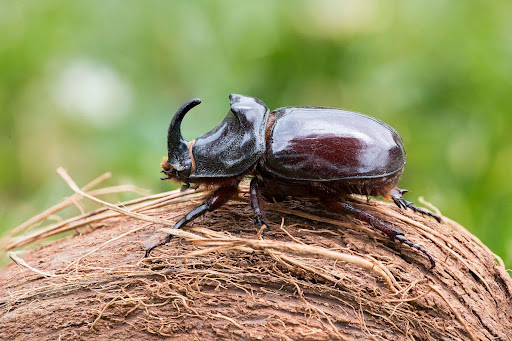
Vanuatu's coconut industry, a cornerstone of the country's rural economy and food supply, is facing one of its most persistent agricultural threats in decades. The Coconut Rhinoceros Beetle (CRB), an invasive pest that burrows into the growing shoots of coconut palms and damages their internal structures, has spread across several islands, including Santo and Efate, disrupting production and placing thousands of livelihoods at risk.
The infestation has compounded existing pressures from aging plantations and climate-related shocks. Coconut-derived products such as copra and oil remain central to household income across rural Vanuatu, making containment of the pest both an agricultural and economic priority.
In response to reports that CRB had spread beyond Efate to Santo, the Vanuatu Future Fund (VFF) provided financial support to assist the Department of Agriculture and Biosecurity in accelerating containment efforts. The funding enabled rapid field deployment and coordination around a national response focused on recovery, prevention, and long-term agricultural renewal rather than temporary eradication measures.
"The beetle outbreak placed years of agricultural progress at risk," said Daniel Agius, Director of the Vanuatu Future Fund. He noted that the objective was to strengthen the systems underpinning coconut production to ensure resilience beyond the immediate crisis.
Launching a Local Nursery in Malekula
On 9 September 2025, PRV and Vanuatu Basket, with support from the Future Fund, launched a new coconut nursery at PRV in Malekula. The facility serves as the foundation of a five-year replanting strategy aimed at restoring local coconut production through biosecure, community-managed propagation.
Biosecurity restrictions limit the transfer of seedlings between islands, making localized nurseries essential. Malekula was selected due to its soil conditions, climate, and access to water, allowing for large-scale seedling production without increasing cross-island contamination risks.
The nursery began with 3,300 coconut seedlings, with plans to introduce approximately 3,000 additional seedlings each week. Distribution will initially focus on Bushman's Bay and Norsup, areas experiencing declining yields from aging coconut trees. Later phases are expected to introduce cocoa seedlings to support crop diversification and income stability for smallholder farmers.
A National Framework for Replanting and Pest Control
The Malekula nursery operates within a broader five-year planning framework intended to improve forecasting, land-use coordination, and long-term supply management. Officials involved in the project say the framework allows authorities to assess annual seedling demand and maintain adequate nursery capacity across provinces.
This work aligns with an expanded national response launched in late 2025 through the extension of a CRB management project funded by New Zealand's Ministry of Foreign Affairs and Trade (MFAT). Implemented by the Bioeconomy Science Institute of New Zealand in partnership with Biosecurity Vanuatu, the project extension runs through 2026 and focuses on scaling local production and delivery of biocontrol agents.
The extension commenced with stakeholder consultations, biocontrol production training, and the establishment of a national CRB Taskforce to strengthen coordination across government, research institutions, and the private sector. Key activities include the controlled release of Metarhizium majus fungus and Oryctes nudivirus (OrNV), enhanced island-wide monitoring, systematic palm damage assessments, and capacity building for in-country biocontrol production.
The Taskforce brings together representatives from the Vanuatu Agricultural Research and Technical Centre (VARTC), the Department of Agriculture and Rural Development, the Department of Environment, Biosecurity Vanuatu, provincial governments including SHEFA and SANMA, the Vanuatu Maritime Safety Authority, and private industry stakeholders.
According to the Ministry of Agriculture, coconut products contribute approximately 15 percent of Vanuatu's agricultural GDP, with an estimated 80 percent of rural households relying on coconut farming for at least part of their income. The spread of CRB has therefore posed a systemic risk to food security and rural livelihoods.
Community Participation and Early Progress
By 10 September 2025, the first planting phase of the Malekula nursery was completed, with 1,081 coconuts planted and prepared for germination. Preparatory work for subsequent phases began immediately, supported by favorable rainfall.
Local residents played a central role in land preparation, irrigation, and pest-management activities. Agricultural officers trained farmers to identify CRB larvae and eliminate breeding grounds, reinforcing prevention alongside replanting efforts. Community participation has also increased awareness of long-term pest management and agricultural planning.
The involvement of younger residents has been notable, with coconut and cocoa farming increasingly viewed as viable long-term employment pathways rather than declining trades.
Toward Long-Term Agricultural Recovery
The CRB response reflects an approach that combines development funding, public-sector coordination, research, and local participation. Rather than functioning solely as an emergency intervention, the nursery project and biocontrol expansion aim to establish sustainable agricultural systems capable of withstanding future shocks.
The Future Fund's role highlights a broader policy shift toward linking investment mechanisms with measurable development outcomes. Success will be assessed not only by the number of trees replanted, but by the durability of supply chains, the effectiveness of pest control, and the strength of farmer education and engagement.
If successful, the Malekula initiative could serve as a model for other island nations confronting similar invasive pest and climate challenges, demonstrating how coordinated planning and local ownership can underpin long-term agricultural resilience.
"The challenge is significant," Agius said. "But the progress we have made shows what can happen when local communities take ownership of their resources. That is how recovery begins."


