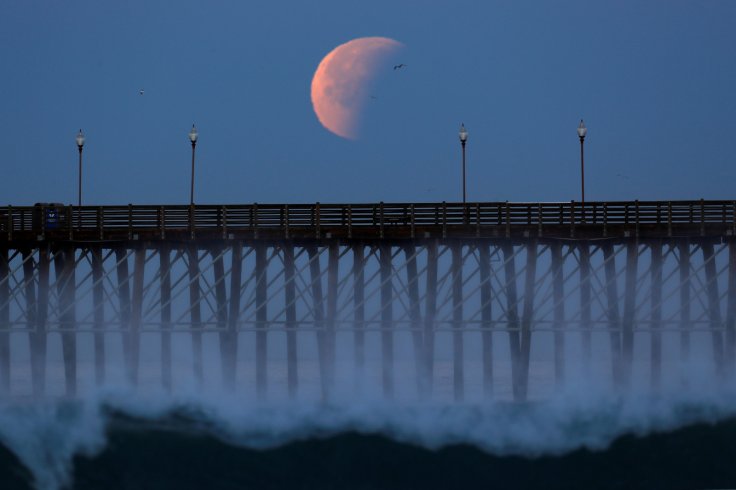
As winter nights stretch long and cold, the moon takes centre stage, rising like a glowing lantern over the horizon. Early January will offer skywatchers a dramatic celestial welcome to the new year, as the first full moon of 2026 appears not only full, but bigger and brighter than usual — a spectacle known as the wolf supermoon.
The wolf supermoon reaches its full phase early on Saturday, January 3, 2026, marking the first full moon of the year. Traditionally named for mid-winter and linked to the howling of wolves in North America, the wolf moon is also a supermoon, meaning it occurs when the moon is close to Earth in its orbit. As a result, it will appear slightly larger and more luminous than an average full moon.
Astronomically, the moon will be technically full at 5:03 am EST on January 3. However, skywatchers are encouraged to focus less on the exact moment and more on the visual experience later that day, when the moon rises in the east shortly after sunset. A full moon is often most striking at moonrise, when it appears oversized near the horizon against the fading colours of twilight.
This wolf moon is the final supermoon in a rare sequence of four that began in October 2025, following the harvest moon, beaver moon and December's cold moon. Supermoons occur when a full moon coincides closely with perigee — the nearest point in the moon's slightly elliptical orbit around Earth.
Viewing conditions on January 3 are expected to be particularly favourable in many locations. In New York, sunset will occur at 4:40 pm EST, with moonrise following about 16 minutes later at 4:56 pm, placing the event squarely in early twilight. In Los Angeles, the moon will rise at 5:25 pm PST, roughly half an hour after sunset, creating an ideal "blue hour" moonrise. Observers are advised to find a clear, east-facing horizon, such as an elevated area, open field or beach, to enjoy the best view.
While the wolf moon will look full to the naked eye as it rises, binoculars can enhance surface details, especially along the bright lunar plains and darker maria. No special equipment is required, and the moon's brilliance makes it one of the most accessible sky events for casual observers.
January's full moon also holds another distinction: it will be the highest-hanging full moon of the year in the Northern Hemisphere. Because the moon's path across the sky mirrors that of the sun, a full moon occurring near the winter solstice — when the sun is lowest — climbs especially high and remains above the horizon longer. This gives observers more time than usual to admire its passage across the night sky.
The wolf moon also signals the start of a busy year for lunar events. The next full moon, known as the snow moon, will occur on February 1, 2026. In total, 2026 will feature 13 full moons, including a blue moon on May 31, which follows May 1 flower moon. The extra full moon arises because a lunar year is about 11 days shorter than a solar year, allowing an additional full moon to fit into the calendar.
Adding to the month's astronomical highlights, Jupiter will reach opposition on January 10, rising at sunset and shining at its brightest for the year. Together, these events make early January an ideal time for stargazing, with the wolf supermoon providing a dramatic opening act to 2026's-night sky.


