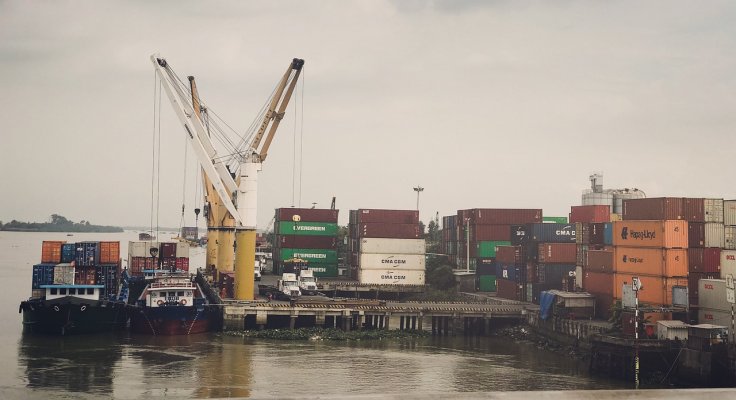
Vietnam's total trade turnover has exceeded US$900 billion for the first time, marking a major milestone in the country's economic integration with global markets, according to the General Department of Vietnam Customs (GDVC).
At a ceremony held on December 25 to announce the sector's key achievements, GDVC said the country's total trade value was expected to surpass the US$900 billion mark by December 26, 2025 — the highest level ever recorded.
For the full year, Vietnam's total trade turnover is projected to reach about US$920 billion, representing a year-on-year increase of 16.9%.
Exports in 2025 are estimated at US$470.59 billion, up 15.9% from the previous year, while imports are projected to rise 18% to US$449.41 billion. The figures translate into an estimated trade surplus of US$21.2 billion, extending Vietnam's streak of maintaining a surplus for 10 consecutive years.
With the latest results, Vietnam has entered the group of the world's 25 largest trading economies. Data from the World Trade Organisation shows that Vietnam currently ranks 21st globally in exports and 20th in imports, climbing 11 and 12 places respectively over the past decade.
The foreign direct investment (FDI) sector continues to play a dominant role in the country's trade performance.
In 2025, total import-export turnover of FDI enterprises is expected to exceed US$600 billion for the first time, reaching about US$663 billion. This accounts for roughly 72% of Vietnam's total trade value and contributes nearly all of the overall trade growth. In contrast, the import-export turnover of domestic enterprises is estimated at around US$257 billion, remaining largely flat compared with the previous year.
Speaking at the event, GDVC deputy director-general Nguyen Van Tho noted that Vietnam's achievements came despite a challenging global and regional economic environment in 2025, as well as the impact of natural disasters, storms and floods that disrupted production and business activities.
He said the milestone underscored Vietnam's position as a highly open economy with deep international integration and a growing presence in regional and global trade.
Tho attributed the strong performance to timely policy direction from the Party and Government, including measures to support businesses, stabilise the macroeconomy and enhance national competitiveness.
He also highlighted the efforts of the business community, as well as close coordination among ministries and agencies, particularly the Ministry of Finance and the customs sector.
According to GDVC, progress has been supported by initiatives to facilitate import-export activities, make better use of free trade agreements, expand export markets, improve logistics and reduce costs for enterprises.
The customs sector has also advanced administrative reforms, accelerated digital transformation and strengthened cooperation through mechanisms such as the National Single Window and the ASEAN Single Window.
Vietnam currently maintains trade relations with more than 230 countries and territories. China remains its largest trading partner, with estimated bilateral trade of US$252 billion in 2025, followed by the United States at US$170 billion. Together, the two markets account for about 46% of Vietnam's total trade turnover and contribute roughly 62% of the country's overall trade growth.
Looking at longer-term trends, GDVC data shows that Vietnam's total trade value reached US$5.52 trillion between 2015 and 2024. Trade turnover expanded from about US$328 billion in 2015 to US$786 billion in 2024, a 2.4-fold increase over the decade.
The number of export products with annual turnover exceeding US$1 billion has also grown steadily, rising from 10 items in 2007 to 36 in 2024. Vietnam is expected to maintain the same number of billion-dollar export items in 2025, reinforcing its transition from persistent trade deficits in the past to sustained trade surpluses over the last decade.


