Think of an evening in late 2025, where a single AWS region flickers for just 17 minutes; but with an impact that is brutal. A large amount of $258,000 disappears every 60 seconds for the average big enterprise. Worldwide, downtime now drains off $400 billion annually from the global top 2,000 companies alone, while the cloud market itself has risen to $912 billion, supporting 94% of all businesses. These stats are the real cost of blind slots in a digital economy that always stays active.
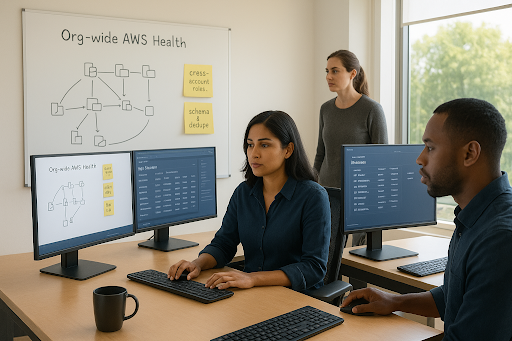
One expert enterprise engineer saw the issue coming and built a solution that turned scattered alerts into a single, live map of cloud health. During his time at Amazon, Srinivasa Atta, designed the first end-to-end system to aggregate AWS Health events across entire organizations. His blueprint, published on the official AWS Blog in 2020, uses AWS Organizations and Amazon Elasticsearch Service (now known as Amazon OpenSearch Service) to extract every warning, outage notice, and maintenance flag into one searchable and drill down dashboard. No more guessing which account is asking for aid.
It is observed that large retailers, banks, and logistics firms often run 500 to 5,000 AWS accounts. Before Srinivasa's solution, the industry was struggling, with storage glitch in one region affecting hundreds of teams separately. Engineers in Tokyo, Dublin, and Sao Paulo would all open tickets, run the same diagnostics, and chase the same root cause, wasting days. Communication lagged, as leadership stayed clueless until customers started asking answers to their problems. Srinivasa himself described the old reality bluntly, "A single underlying AWS service issue would trigger hundreds of separate, uncoordinated internal alarms and investigations."
The pain was not theoretical. In 2017, an S3 outage in US-East-1 took down half the internet for four hours. In 2021, Fastly's CDN failure blacked out news sites, government pages, and e-commerce giants in one swoop. Retailers lose $6.6 million per hour of peak-season downtime on average; airlines hemorrhage $1.2 million. Every minute counts when your checkout page is a 404 error.
Srinivasa's system attacks the root problem, that is "visibility". It grabs events the moment AWS Organizations APIs publish them, routes them through Lambda for instant processing, and provides them in Elasticsearch for filtering, searching, and graphing. Central teams now see every affected account, region, and service in one glance. Detection time drops from hours to under five minutes, which is a 95% gain. Duplicate tickets vanish. A retailer hosting Cyber Week sales can detect a database slowdown across 400 accounts and manage traffic proactively to prevent abandoned carts. The platform also aggregates "scheduled change" events, such as planned hardware upgrades or infrastructure maintenance, facilitating teams to plan ahead, reschedule workloads, or fail over services before disruption occurs, dramatically lowering avoidable downtime.
The commercial payoff is immediate, as the global retail chains use the dashboard to protect flash-sale windows that generate 40% of annual revenue in 48 hours. Logistics companies track fleet-tracking apps across continents, ensuring drivers stay routed even if a backend cache fails. Payment processors see every gateway health flag and reroute transactions before declines spike. Over time, businesses have begun to use the aggregated data for historical trend analysis, identifying which AWS regions or services failed most often and using that intelligence to strengthen future architectural decisions.
From the societal point of view, hospitals running telehealth on AWS can promise patients uninterrupted video consults. Food-delivery platforms in emerging markets keep drivers earning during peak dinner hours. Educational nonprofits streaming classes to rural kids avoid black-screen afternoons. When cloud reliability improves, the digital divide shrinks. Srinivasa Atta's own words capture the shift: "It empowered central IT and leadership teams to see the full picture instantly." Leadership teams now also receive weekly or monthly operational health reports automatically generated from the dashboard, giving executives clear visibility into system stability, hotspots, and improvement trends. For regulated industries, the centralized view doubles as a long-term audit trail of all AWS service health events; indispensable for compliance documentation, post-incident reviews, and proving operational diligence.
The architecture has spread like wildfire, with hundreds of businesses, from Fortune 500 manufacturers to mid-sized SaaS startups, have forked the open code, tweaked the queries, and run it in production. AWS itself took notice, with features in Control Tower and Systems Manager now reflecting the centralized views he pioneered. The blog post, even five years later, remains a top search result, still guiding new adopters through the same diagrams and CloudFormation templates.
Retail giants feel the difference most acutely; for instance, a North American big-box chain used the dashboard to correlate a Route 53 latency spike with abandoned carts in real time, shaving 1.8% off bounce rates during a holiday promo. An Asian e-commerce company spotted early signs of Kinesis performance issues and quickly increased capacity, saving $2.3 million in projected revenue.
These initiatives by experts like Srinivasa Atta are helping lay the foundation for innovation in tech, which is only the starting line. As companies layer machine-learning models on the same Elasticsearch indices, they are building predictive alerts, flagging capacity trends before AWS even posts a health event. Hybrid multi-cloud setups are integrating the pattern onto Azure and GCP event streams, creating true cross-provider panoramas. The next leap could blend generative AI to auto-draft incident playbooks the moment a dashboard tile turns red.
In a generation racing toward ambient computing, where smart cities, autonomous supply chains, and always-on finance depend on zero-friction infrastructure, Srinivasa's work is a critical pillar. It won't grab headlines like a new rocket launch, yet every minute of prevented downtime translates to smoother commutes, faster emergency responses, and fairer access to digital tools. The dashboard he designed in 2020 keeps evolving, but its core promise remains, that is, turning hindrances into clarity, and letting the cloud finally earn the trust we've placed in it.


