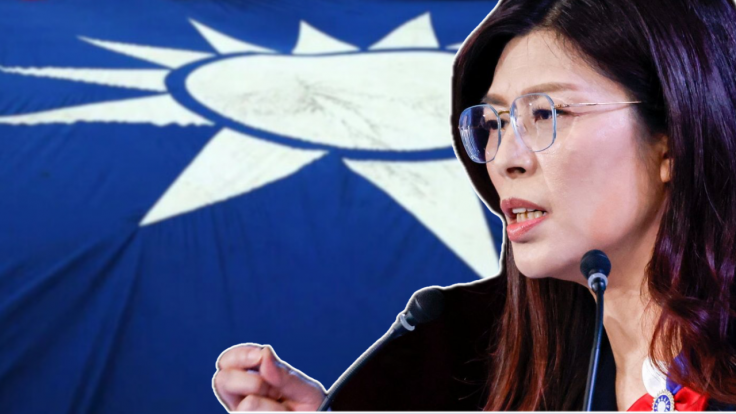
On October 18, in a message congratulating Cheng Li-wun, the newly elected leader of the Kuomintang (KMT), Taiwan's main opposition party, Chinese President Xi Jinping called for efforts to advance 'reunification'.
The Taiwanese should think twice before joining Communist China.
Of course, Beijing will promise, 'One Country, Two Systems' to their Taiwanese 'countrymen and women' living on the island, but the sloganhas lost much of its relevance after Hong Kong went back to the People's Republic of China (PRC) in 1997.
Hong Kong was to operate as a Special Administrative Region (SAR) with a high degree of autonomy under Chinese sovereignty, however in recent years, Beijing has been increasingly asserting its control; the Hong Kongers helplessly witnessed the gradual erosion of their freedom.
The Taiwanese should also look at the example of Xinjiang, which was annexed as 'The New Dominion' by the PRC in 1949/1950.
Today, the Chinese Communist Party (CCP) is implementing a new strategy known as the 'Cultural Enrichment of Xinjiang', in other words the 'Cultural Assimilation of Xinjiang'.
Recently, Xi Jinping attended the 70th anniversary celebration of the founding of the Xinjiang Uyghur Autonomous Region. He watched a gala entitled 'Beautiful Xinjiang'. Xinhua News agency explained: "The gala is structured in three parts. The first part presents the vibrant efforts in Xinjiang's socialist construction. The second part showcases the dynamism brought by reform and opening up to the region while the final part depicts the beautiful vision of people of all ethnic groups in Xinjiang working together to pursue their dreams in the new era."
It is not what the UN and human rights organizations have experienced; in fact, most observers believe that it is rather a systematic program of cultural and demographic colonization, eroding Uyghur traditions, language, and identity.
During his speech in Urumqi, Xi is quoted by Sputnik, the Russian newspaper as speaking of strengthening the "sense of a unified Chinese national community, promoting the Sinicization of religion, and advancing 'Cultural Enrichment of Xinjiang' to instill what the Party calls 'correct views' on nation, history, ethnicity, culture, and religion among all ethnic groups." In other words, completed assimilation.
The Great Firewall
On October 2, a leaked document provides a rare insight into the expansion of Xinjiang's firewall project.
A firewall is a network security system monitoring and controlling incoming and outgoing network traffic to prevent so-called unauthorized access; in fact, it is the best way to censure Internet traffic.
In its report, The Great Firewall Project demonstrated, with technical examples, how China is increasingly expanding its internal firewall systems on a provincial level, in addition to the big national Great Firewall (GFW).
Geedge Networks, a company with ties to the founder of China's mass censorship infrastructure, is selling its censorship and surveillance systems to at least four other countries in Asia and Africa. According to leaked data, Geedge Networks also supports the Myanmar military juntaby "enabling the tracking of network traffic at the individual level andidentifying the geographic location of mobile subscribers in real time".
It was suspected for a long time that the region was running its own version of the Great Firewall; now it is confirmed and the code-name of this 'tuned' system is 'Xinjiang 912' with '912' referring to the September 12 terror attacks in the restive province in 2014.
Do the Taiwanese want to come under such a system?
The problem is the deep, constant and open interference of the PRC in the island internal affairs; already the KMT's internal vote to elect a president was overshadowed by accusations of Chinese interference.
But it is not all; on September 29, the Politburo of the Chinese Communist Party (CCP) had a 'collective study session on advancing the Sinicization of religion in China'; it was chaired by Xi Jinping, whoemphasized that this initiative is essential for promoting "religious harmony, ethnic unity, social harmony, and national stability."
One of the core requirements of the Communist Party is to align religion with socialist society under the CCP's leadership. Xi further called for strengthening the ''Five Identifications' – with the motherland, the Chinese nation, Chinese culture, the CCP, and socialism with Chinese characteristics; the president urged active participation of all in the Chinese-style modernization program.
Tibet too comes under heavy censorship, the Chinese authorities have reportedly forced thousands of Tibetans, including monks, nuns, and some high-ranking lamas to attend a Kalachakra puja led by Gyaltsen Norbu, the Chinese-appointed Panchen Lama.
The four-day ceremony was held from October 9 to 12 at the Kyi-kyiNakha site of Tashi Lhunpo Monastery, the traditional seat of the Panchen Lamas in Shigatse.
Already, in 2016, Norbu presided over a similar Kalachakra puja at Dechen Phodrang, near Tashi Lhunpo Monastery. A controversy had erupted following reports that Chinese officials offered money to Tibetans to participate.
Earlier this month again, the city was placed under intense security and surveillance, "with heavy deployment of police and military personnel. Officers disguised as medical workers were reportedly seen monitoring and controlling the crowd at the venue," says Phayul, a Tibetan website in Dharamsala.
Living in India, one has sometimes the impression that life is chaotic, especially during the election's times, when each party is trying to outdo the other with unimplementable promises, but examples such as the above show that this is a tiny price to pay for the freedom to choose (and change) one's own leaders.
The 'rebel' island today experiences in democracy, with its defects and its positive aspects, one can only dream that a similar system will also one day be adopted in the Mainland China. It will indeed be a great day for humanity.
[This is an authored article by Claude Arpi, a French-born author, journalist, and tibetologist born in 1949 in France. He lives in Auroville, India. He is the author of several books including The Fate of Tibet: When Big Insects Eat Small Insects and several articles on Tibet, China, India and Indo-French relations.]


