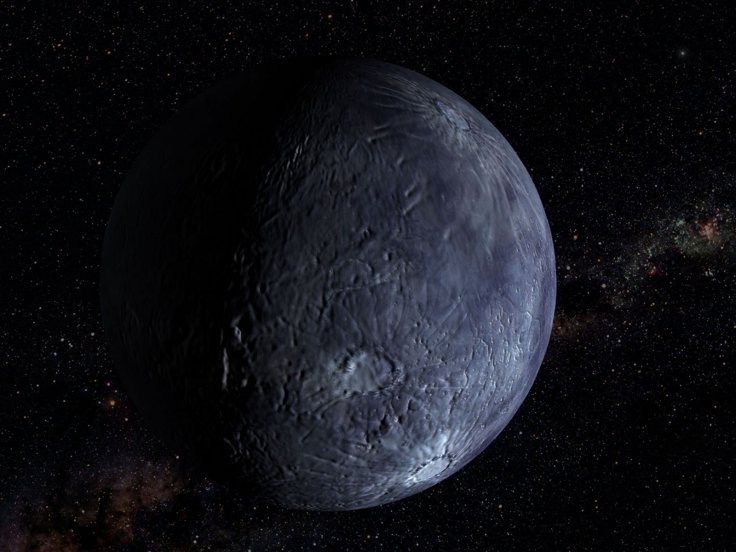
Scientists have found what they believe to be a second moon circling Quaoar, a far-off dwarf planet. This was an unexpected and coincidental discovery of a small, icy, egg-shaped planet in the outermost reaches of our solar system, beyond Neptune, which is already known to have two rings and a moon.
On June 25, 2025, the hitherto unidentified satellite was found when it passed in front of a far-off star during a stellar occultation event.
In order to gain more insight into the planet's known ring, Q1R, astronomers were already monitoring it and anticipated that it would temporarily reduce the brightness of the background star. Rather, for 1.23 seconds, something else totally obscured the starlight.
This implied that the new object was either a dense ring or a satellite. Instead of a faint, dusty ring, the light signature is what one would expect from something solid like a moon.
"Given the lack of other credible explanations, the most likely cause of this MIRA occultation was by material orbiting Quaoar; either a new satellite, or third ring," wrote the researchers in a paper published in the Research Notes of the AAS.
Although prior James Webb Space Telescope (JWST) observations revealed no evidence of a third ring at this location, astronomers do not rule out the possibility. The satellite hypothesis gains credibility as a result.
Beyond Neptune, in the vast ring of icy planets known as the Kuiper Belt, sits the far-off planet Quaoar. It orbits the sun in 286 Earth years and has a radius of 345 miles. Weywot, its only known moon, orbits Quaoar at a distance of roughly 9,000 miles.
Its Roche limit, where a planet's gravity would rip smaller orbiting bodies apart, is outside the two rings, which were found in 2023. The conventional wisdom holds that moons should form outside the Roche limit, whereas these rings only exist near planets, making their existence perplexing.
This finding challenges our preconceived notions about the formation of rings and moons and deepens the mystery surrounding the Quaoar system. The precise nature of the object and the presence of additional satellites or rings may be confirmed by additional observations and JWST imaging.
This could provide fresh insight into the formation of planetary systems in the icy, far-off regions of the Milky Way in addition to providing additional information about the enigmatic Quaoar.


