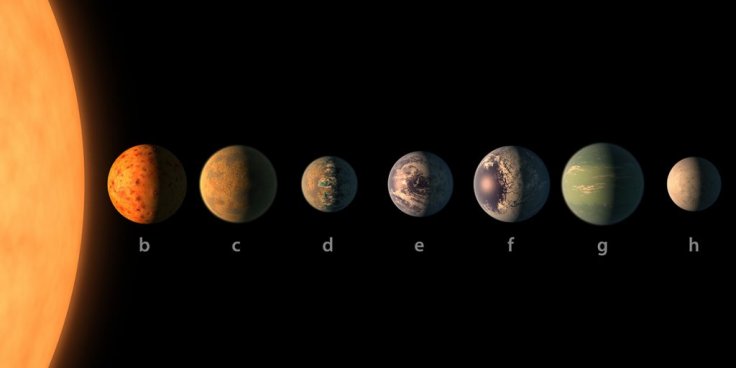
Scientists have used NASA's powerful James Webb Space Telescope (JWST) to study the atmosphere and possible habitability of a well-known "Goldilocks zone" planet. And here's something quite interesting from the latest research, which was published as two papers on Monday, September 8, in The Astrophysical Journal Letters.
The planet in question is called TRAPPIST-1e, and it is a rocky exoplanet about 40 light-years away from Earth.
The fourth planet in orbit of the red dwarf star TRAPPIST-1 is known as TRAPPIST-1e. It is in the "habitable zone" or Goldilocks zone, which is the area of space surrounding a star that is just right—not too hot or too cold—for liquid water to exist on a planet's surface.
However, simply being in a star's habitable zone does not ensure that liquid-water oceans will exist or even that the conditions necessary for life will exist. Even though Earth, Mars, and Venus are all in the habitable zone of our solar system, only one of them has oceans and is home to life as we know it today.
Astronomers are looking for our planet's atmosphere around TRAPPIST-1e because it is one of the main differences.
Ryan MacDonald, a researcher at the University of St. Andrews in Scotland, said in a statement, "TRAPPIST-1e has long been considered one of the best habitable zone planets to search for an atmosphere."
"But when our observations came down in 2023, we quickly realized that the system's red dwarf star was contaminating our data in ways that made the search for an atmosphere extremely challenging," added MacDonald.
A number of scenarios for TRAPPIST-1e and its possible atmosphere are suggested by the JWST data. Thus, this study represents a major advancement in the hunt for extrasolar life.
The team had to wait until TRAPPIST-1e crossed or "transited" the face of its parent star in order to investigate its possible atmosphere. Because chemicals absorb light at specific wavelengths, this provides information about the chemical makeup of a planet's atmosphere.
This implies that the chemicals in a planetary atmosphere leave their distinctive "fingerprints" in the spectrum when starlight travels through it.
This isn't as simple as it seems. Factors such as star spots on the red dwarf star's face must be taken into consideration by astronomers.
In order to focus on the planet's atmosphere—or lack thereof—the team has been meticulously eliminating contamination from the TRAPPIST-1e data for the past year.
"We are seeing two possible explanations," MacDonald said. "The most exciting possibility is that TRAPPIST-1e could have a so-called secondary atmosphere containing heavy gases like nitrogen. But our initial observations cannot yet rule out a bare rock with no atmosphere."
Since the team's results are uncertain, JWST is far from done with TRAPPIST-1e. With each transit, the researchers hope to get a better idea of the planet's atmospheric composition and conduct a more thorough search for it.
MacDonald concluded, "In the coming years, we will go from four JWST observations of TRAPPIST-1e to nearly 20."
"We finally have the telescope and tools to search for habitable conditions in other star systems, which makes today one of the most exciting times for astronomy," the researcher added.


