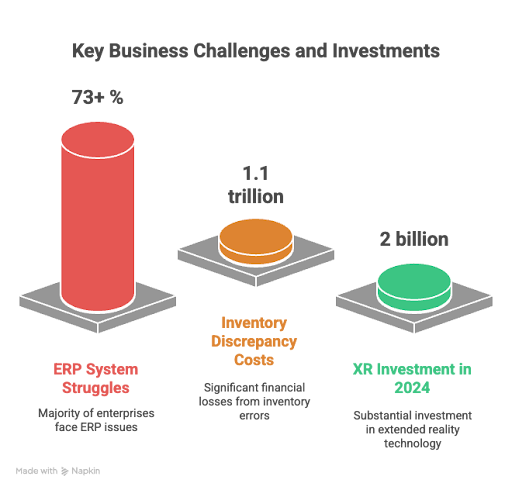
Global supply chains are breaking. According to recent McKinsey research, 73% of enterprises report that their ERP systems can't keep pace with multi-location operations, while Gartner estimates that inventory discrepancies cost businesses $1.1 trillion annually. As companies struggle with Excel-based tracking and disconnected systems, a new crop of tech startups is proposing an unusual solution: virtual reality headsets in warehouses.
The $50 Billion Problem Nobody Talks About
"Most Fortune 500 companies are still running their warehouses like it's 1995," says supply chain analyst Michael Chen from Forrester Research. "You have billion-dollar operations managed through spreadsheets that don't talk to each other."
The numbers back this up. A recent SAP study found that 67% of enterprises experience critical inventory blind spots at least monthly, while manual stock counts consume an average of 3,000 work hours annually for mid-sized distributors. These aren't edge cases they're industry norms that companies rarely discuss publicly.
This operational crisis has attracted venture capital attention. Investment in enterprise XR solutions jumped from $180 million in 2022 to over $2 billion in 2024, according to PitchBook data. Among the companies raising funds is AvanSaber, a USA-based startup that recently closed its Series A to develop what it calls "spatial computing for inventory management."
Virtual Warehouses Meet Physical Reality
AvanSaber's approach centers on StockVR, a platform that creates digital twins of warehouse inventory. Using XR headsets currently supporting Meta Quest and Microsoft HoloLens warehouse managers can reportedly view real-time 3D representations of stock across multiple locations simultaneously.
"The traditional approach has workers physically walking warehouses with clipboards or handheld scanners," explains co-founder Nikhil Jathar in a video demonstration. "We're testing whether virtual navigation can cut audit times by 60-70%."
The company claims early trials with unnamed enterprise clients showed measurable improvements, though independent verification of these metrics remains limited. The platform integrates with existing SAP and Oracle systems, though another co-founder Varun Borawake acknowledges that legacy system integration "remains our biggest technical challenge."
AvanSaber isn't alone in this space. Competitors like Scandit (Switzerland) and Dexory (UK) are pursuing similar augmented reality solutions, while tech giants Microsoft and Google have their own enterprise XR initiatives. Magic Leap, despite its consumer market struggles, has pivoted entirely to enterprise applications with a $500 million funding round specifically for warehouse automation.
The Walmart Factor
What gives smaller players credibility is the movement of retail giants in the same direction. Walmart's recent announcement of its AR-powered inventory system across 4,700 stores suggests that immersive technology might have found its killer app in logistics rather than gaming.
"When Walmart moves, the industry watches," notes retail technology consultant Sarah Martinez. "Their adoption of AR for inventory management validates what startups have been claiming for years that spatial computing can solve real operational problems."
However, Martinez cautions that Walmart's resources dwarf those of typical enterprises. "They can afford to experiment with a 20% failure rate. Most companies can't."
Beyond the Headset: The Automation Stack
AvanSaber's broader strategy extends beyond VR. The company has developed AutoBotWriter, an AI tool for automating documentation and reporting addressing what Borawake calls "the hidden time sink of enterprise operations." They've also partnered with UtilitiesLabs.com, a research firm focused on ERP implementation, though details of this collaboration remain vague.
This multi-tool approach mirrors a trend among enterprise startups. "Nobody wants another point solution," says venture capitalist David Kim from Andreessen Horowitz. "The winners will be platforms that solve multiple pain points in the operational stack."
Yet industry observers remain skeptical about the integration claims. "Every startup promises seamless integration," says Chen. "In reality, connecting to a 20-year-old SAP installation is incredibly complex. Most POCs fail at this stage."
The Reality Check
Despite the hype, significant barriers remain. A Deloitte survey found that 68% of enterprises cite change management not technology as their biggest digital transformation challenge. Teaching warehouse workers to use VR headsets presents practical hurdles, from motion sickness to battery life limitations.
Cost is another factor. While headset prices have dropped, outfitting a large warehouse operation still requires substantial investment. "The ROI calculations look great on paper," says Martinez. "But factor in training, maintenance, and the inevitable technical issues, and the math gets complicated."
There's also the question of standardization. With multiple competing platforms and no industry standards for XR in logistics, early adopters risk investing in technologies that could become obsolete.
What's Next
The enterprise XR market is expected to reach $125 billion by 2030, according to IDC forecasts. Whether companies like AvanSaber capture a meaningful share depends on their ability to prove ROI beyond pilot programs.
"The technology is impressive in demos," concludes Chen. "But we've seen impressive demos before. The real test is whether these solutions can scale across thousands of warehouses with different layouts, systems, and workforces."
For now, enterprises appear willing to experiment. As supply chain pressures intensify and labor shortages persist, even unconventional solutions are getting serious consideration. Whether that translates to widespread adoption remains the billion-dollar question that startups like AvanSaber are betting their futures on.


