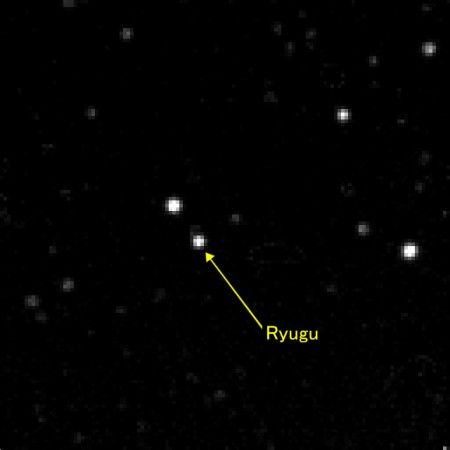
The asteroid Ryugu is proven to be one of the solar system's most scientifically valuable time capsules. Wondering why? Here you go!
A recent examination of miniscule grains recovered from Ryugu by Japan's Hayabusa2 spacecraft discovered that the small space rock contains minerals that developed billions of years before Earth – materials that have been preserved in immaculate shape.
Brookhaven National Laboratory researchers examined the chemistry of the asteroid samples in extraordinary detail, revealing a mixture of minerals and elements that trace back to the asteroid's ancient parent body, according to a statement from the lab.
"These clues begin to tell a story about the starting materials of the asteroid and their early interactions with fluids," officials said in the statement. "This information helps to better define the sequence of fluid activity and processes that led to the current composition of Ryugu and other carbonaceous asteroids."
Ryugu is a carbon-rich near-Earth asteroid considered to have formed in the chilly outer reaches of the solar system. Radioactive decay, a chemical process that occurred over 4.7 billion years ago, softly warmed the parent body.
That modest heating melted ices like as water and carbon dioxide, allowing fluids to leak through the rock. The fluids stimulated chemical reactions, resulting in a complex material assemblage – some known to Earth, others completely strange.
Researchers identified carbonates such as manganese-bearing dolomite and ankerite, iron-rich minerals like pyrrhotite and magnetite, copper sulfides, phosphorus-bearing hydroxyapatite, a mineral found in human teeth and bones, and a rare phosphide mineral not found on Earth using only two tiny pieces of the asteroid—one grain from its surface and the other from its subsurface.
There were also trace amounts of selenium, sulfur, silicon, and calcium. The diverse range of minerals indicates a complex interplay of fluids and chemistry that occurred billions of years ago in the asteroid, long before our planet's crust hardened.
Because Earth's earliest rocks were damaged by tectonics and erosion, Ryugu provides an unmatched view of the conditions that existed during planetary formation.
The returned samples may also indicate whether the asteroid supplied water and organic compounds that aided in the emergence of life on Earth.
The officials said, "Earth is constantly changing, and, over time, its natural processes have erased most of the chemical clues about how the solar system first formed," adding, "Asteroids like Ryugu preserve this important piece of the solar system's history."
Asteroid sampling missions are quickly expanding as space organizations recognize the unparalleled scientific significance of returning pristine material from the early solar system. Japan's Hayabusa and Hayabusa2 missions laid the groundwork, successfully returning samples from asteroids Itokawa and Ryugu, while NASA's OSIRIS-REx mission just returned material from asteroid Bennu, which astronomers intend to investigate using the same X-ray techniques.
Comparing Bennu and Ryugu may show significant discrepancies in how carbon-rich asteroids evolved, changed, and transported life's critical building elements throughout the early solar system.


