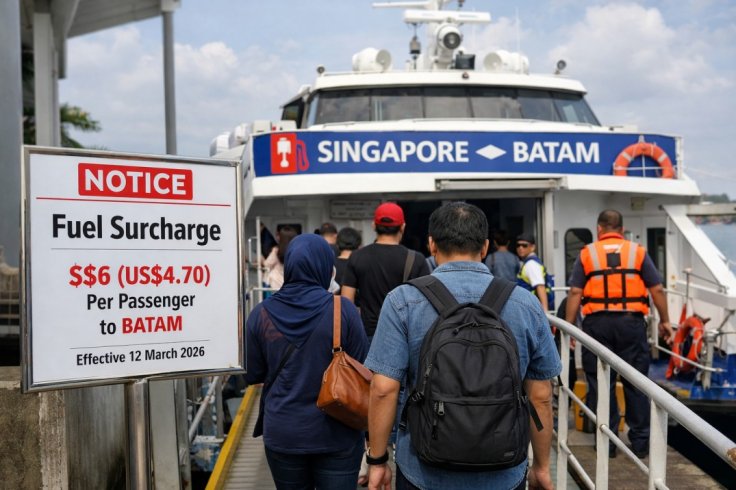
Passengers travelling between Singapore and Batam will soon face higher ferry fares, as several operators introduce fuel surcharges in response to rising global energy prices linked to tensions in the Middle East.
Operators including Horizon Fast Ferry, Majestic Fast Ferry and Batam Fast announced that travellers departing from Singapore to Batam will have to pay a S$6 (US$4.70) fuel surcharge starting from Thursday, March 12.
In a notice published on its website, Horizon Fast Ferry said, "This measure is necessary to offset rising operational costs while ensuring the continued delivery of safe, reliable and efficient services."
The company added that it would continue monitoring the situation and adjust the surcharge if necessary.
The additional charge will apply to all ferry tickets, including those purchased before the implementation date, and will be collected at the operators' ticket counters before departure.
Batam Fast also announced further surcharges on other regional routes. Passengers travelling to Desaru Coast will face an additional S$12 fee, while those heading to Pengelih, Malaysia, will pay a S$6 surcharge.
The price adjustments come amid rising global energy costs triggered by escalating conflict involving the United States, Israel and Iran. The situation has disrupted shipping through the Strait of Hormuz, a critical waterway through which about 20% of the world's daily oil consumption typically passes.
Attacks on vessels in the strait by Iran's Revolutionary Guards have heightened concerns over the stability of global energy supplies. Iranian military spokesperson Ebrahim Zolfaqari warned that oil prices could surge significantly due to the deteriorating security situation in the region.
Despite efforts by the International Energy Agency to ease supply concerns by releasing 400 million barrels of oil from member countries' reserves, market fears remain strong. Brent crude prices climbed 9.3% to US$100.50 per barrel, while West Texas Intermediate rose 8.8% to US$94.92 during early trading on Thursday.
The disruptions are also affecting liquefied natural gas (LNG) supply chains in Asia, where nearly one-third of imports pass through the Strait of Hormuz.
Singapore's Minister-in-charge of Energy and Science & Technology, Tan See Leng, said that the closure of the key shipping route is likely to push global fuel prices higher in the near term.
In a Facebook post on Thursday, Dr. Tan noted that increasing geopolitical uncertainty has made fuel disruptions and price fluctuations more common. He added that Singapore has taken steps to strengthen its energy security, including diversifying its sources of imported LNG.
"The government also stands ready to support households and businesses as necessary," he said, as authorities continue to monitor the evolving global energy situation.